This post contains affiliate links please see the Disclosure and Privacy Policy page for full disclosures here.
In the world of early childhood education, the debate between process art and project art has been a topic of stimulating discussion. Just ask your favorite mommy group online and you will get people on both sides of the argument very quickly getting upset at the other side. Understanding the fundamental differences between these two approaches is essential for fostering creativity and supporting development in preschoolers and toddlers. In this article, we’ll explore the unique characteristics of project art, which focuses on achieving a specific end product, and process art, which values the creative journey above the final outcome.
Project Art
Project art is a valued type of art for preschoolers and toddlers. First off, project art is goal oriented. It focuses on achieving a specific end product while following a step-by-step guide. Children are provided clear instructions and guidelines to create a predetermined outcome.

This type of art focuses often on replicating a predetermined model or piece of artwork. Children are encouraged to pay attention to specific details to follow specific the steps or guidelines. Even though it may emphasize specific techniques, skills or themes, this learning is done through structure.
Project art provides a sense of accomplishment when the final product matches the intended outcome, but it often involves more guidance and involvement from adults or teachers.
One of the major issues with project art is that it can limit creativity. It can restrict children to follow a set of instructions which leaves little room for their imagination and personal expression. Children may miss out on the chance to explore various materials, techniques, and artistic concepts freely, hindering their overall artistic growth and cognitive development.
Another issue is that with project art, the emphasis often lies on achieving a certain end product which can lead to performance pressure on young children. This can cause frustration and anxiety if the child struggles to meet the expected outcome.
Check out these great project art activities for preschoolers and toddlers.
Process Art
Process art is very different from project art. It focuses on the experience and creative process rather than the final product. It encourages open-ended exploration, experimentation and self-expression. Children are encouraged to make their own choices, explore different materials, and express their unique creativity.
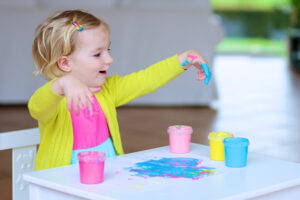
With no specific guidelines or predetermined outcomes, the focus can be on personal interpretation and creativity. It also nurtures imaginative thinking, problem-solving skills, and decision-making abilities because the child is not being held to a specific outcome.
It provides an outlet for emotional expression and allow children to process their thoughts and feelings through art. The process itself is what is valued and celebrated even if the final artwork does not look “perfect” or traditional.
Even though this all sounds good, process art has a few drawbacks. One is that since it prioritizes the creative journey over the final product, the end result may not always be visually impressive or recognizable and this might make some children and adults feel dissatisfied. Also, it can be more challenging to assess. This aspect can make it difficult for educators and parents to evaluate the child’s progress and development.
Engaging in process art can be more time-consuming than project art, as it involves providing children with the freedom to explore and experiment at their own pace. This might not always be feasible in a structured setting.
Check out these great process art activities for preschoolers and toddlers.
Both process art and project art have their own merits and can be incorporated into children’s artistic experiences. Finding a balance between the two approaches can provide a well-rounded art education that supports creativity, skill development, and personal expression.