This post contains affiliate links please see the Disclosure and Privacy Policy page for full disclosures here.
The Magic of Pretend Play Activities with Toddlers
Pretend play activities for toddlers are some of the most imaginative—and chaotic—parts of the early homeschool years. My toddler once pretended his hand was a train chugging along the living room carpet. Toddlers can make believe just about anything!

Life with toddlers is wonderfully wild—especially in a homeschool setting. One of the best ways to harness that energy (and engage older siblings too) is by creating a dramatic play area in your home. We’ve had everything from bustling restaurants to cozy campgrounds take over our living room, with all the kids jumping into the fun.
And while it might buy you a few peaceful sips of coffee, pretend play activities for toddlers are also essential for their growth and development.
What is Pretend Play??
Pretend play activities for toddlers are often called dramatic play. They can be as simple as pretending your hand is a train or as elaborate as turning the living room into a full restaurant.

For this post, we’re focusing on parent-prepared setups—like a play kitchen or grocery store—that invite toddlers into imaginative, child-led play.
This kind of play is unstructured but rich with learning. Toddlers are “learning by doing,” gaining real-world knowledge while also building key skills they’ll need for future learning. You can read more about dramatic play here.
Key Benefits of Pretend Play Activities with Toddlers
Language Development
Pretend play activities for toddlers help develop language skills in amazing ways. According to The Genius of Play, kids use more advanced language during pretend play than in regular conversation.
They practice talking like doctors, chefs, or customers—all through play. This helps build vocabulary and confidence.
They also learn new words by asking questions. “What’s this called?” or “How do I say that?” Playing with others—even siblings—teaches them how to listen and respond.

Pretend play also sparks storytelling. My kids once created a whole grocery store scene. One was the cashier, the other the shopper. They made up names, reasons for shopping, and even added a dinner party plot!
All that storytelling builds the foundation for reading and writing down the road
Emotional Skills
Pretend play for toddlers helps them express big feelings. It’s a safe way to act out frustration, excitement, or even fear.
If a child is upset about a real grocery trip, they might act it out in play. If they’re nervous about the doctor, they can play doctor at home first.
Dramatic play also builds empathy. When toddlers play roles, they imagine how others feel. “Is my customer sad?” “How can I help?”
This simple role play teaches care and compassion.
Pretend play can also build confidence. Acting out real-life situations—like doctor visits—makes them feel brave. They know what to expect.
And they’re doing it all through play.
Social Skills
Pretend play activities for toddlers are a great way to build social skills—especially turn-taking and sharing. In a pretend restaurant, toddlers learn to wait. They might say, “Someone’s ahead of me, so I’ll sit at my table.”
They also practice sharing roles. One might say, “You make the coffee, and I’ll get the pastries.” These moments help toddlers try out social rules in a safe, playful way. No pressure. No real-world consequences.
Problem-solving also shines during dramatic play. My kids love making me the customer in their restaurant. But they always tell me they’re out of everything I order!
So we problem-solve together. What can I order instead? Do we have pretend food that works? Or should they make up something new?
Flexibility grows from those same moments. If they run out of “food,” they adjust. If someone wants to move the restaurant outside, they shift the story together.
Learning to go with the flow is a big win—for both playtime and real life.
Cognitive/PreMath Skills
Pretend play activities for toddlers also build early math skills or cognitive skills—without feeling like a lesson.
- Sorting and Categorizing: At the pretend grocery store, they group items. Fruits go in one basket. Cans go on another shelf.
- Counting: They count items as they ring them up. Or count coins to pay for pretend groceries.
- Matching: Setting the table at the restaurant? They match bowls, plates, and silverware.
- Sequencing: They plan what comes first. Cook the food? Or serve the customer?
- Spatial Awareness: They figure out how to fit everything on a plate. Or how to carry two coffee cups without dropping them.
These early skills lay the groundwork for more formal math later on. And toddlers learn them all through play.

Making Space for Pretend Play in Your Daily Rhythm
As moms, we often feel the pressure to make sure our kids are always learning. Every moment needs to “count.”
“Play is often talked about as if it were a relief from serious learning. But for children, play is serious learning. Play is really the work of childhood.” – Fred Rogers
That means pretend play is learning.
Sometimes, we just need to shift our view of what learning looks like. It doesn’t always come from a book or worksheet. It comes from meeting our children where they are.
One of the easiest ways to start is by following your child’s interests.
If your toddler loves garbage trucks, turn that into pretend play. Let them clean up the room with their toy truck. Grab a cardboard box and help them build their own.
That’s pretend play—and it’s full of learning.

Pretend Play Doesn’t Need to be Pinterest-Perfect
Your child doesn’t need anything fancy to dive into pretend play.
A box can become an airplane.
A toy kitchen can turn into a busy restaurant.
A handful of stuffed animals can create a whole zoo.
One of my favorite resources is from Elevate Toddler Play—Pretend Play Made Simple. It walks you through how to start and how to use what you already have.
And remember—pretend play is still play. It’s okay if it changes halfway through.
As your child’s play evolves, so does their learning.
Dramatic Play Kits Ready to Go for Toddlers
Here are some of our favorite pretend play activities for toddlers—simple setups that spark big learning through imagination:
- Camping Dramatic Play Kit:
Toddlers love pretending to sleep in tents, roast marshmallows, and go on nature hikes—right in the living room. This kit encourages storytelling, outdoor vocabulary, and pretend problem-solving like setting up camp or keeping bears away! - Post Office Dramatic Play Kit:
Perfect for little ones learning about communication and community. Toddlers can sort mail, deliver packages, and even “write” letters. It’s a great way to introduce early literacy and social role-play. - Restaurant Dramatic Play Kit:
This is a toddler favorite for practicing taking turns, serving others, and counting items on a menu. Whether they’re the chef, server, or customer, kids stay engaged while learning language and number skills. - Coffee Shop Dramatic Play Packet:
Toddlers can pretend to brew coffee, take orders, and serve pastries. This one is great for fine motor skills and sequencing—plus, it’s just plain fun to be like mom or dad! - Grocery Store Dramatic Play Kit:
A wonderful way for toddlers to explore sorting, categorizing, and money play. They can shop, check out, bag groceries, and even create their own store rules. It’s perfect for solo or sibling play.
Each kit encourages open-ended play, creativity, and real-world learning—all wrapped in fun, imaginative toddler moments.
You’r Not “Wasting Time”- You’re Building a Foundation
I think we put too much pressure on ourselves to make everything perfect.
We want the setup to be perfect.
We want our toddlers to play “the right way.”
But that’s not the goal.
The goal is learning.
And pretend play activities for toddlers are laying the groundwork for that learning every single day.
Learning doesn’t always look like worksheets.
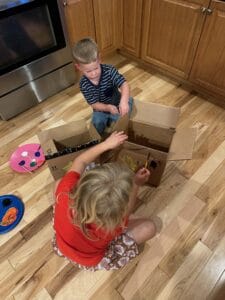
Sometimes, it looks like a cardboard box and a wild imagination.
Comment below:
What’s your toddler’s favorite pretend play scenario?
How has their imagination surprised you?