This post contains affiliate links please see the Disclosure and Privacy Policy page for full disclosures here.
We love pretend play to teach real life skills to preschoolers and toddlers, so we created a restaurant dramatic play area for our house. This teaches them not only skills for how to behave and be in a restaurant, but we also work in some math and reading skills as well.
How we setup our Restaurant Dramatic Play area
We already had a play kitchen with food and a table so our restaurant dramatic play setup was super easy.
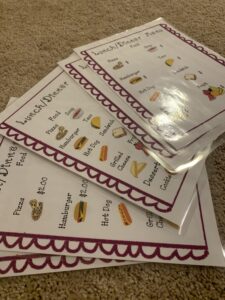
First, I printed out the entire pack and cut it apart. Next, I laminated the entire pack to make it easier to write on with dry erase markers. Then, we worked together to set it all up.
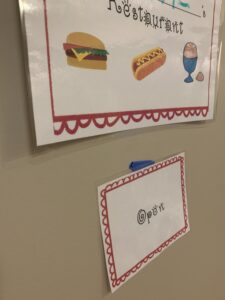
C named her own restaurant and wrote it on the line on the sign. She also wanted to tape it all up by herself. We also added the open sign so that everyone knows the restaurant is ready to go!
Learning through play!
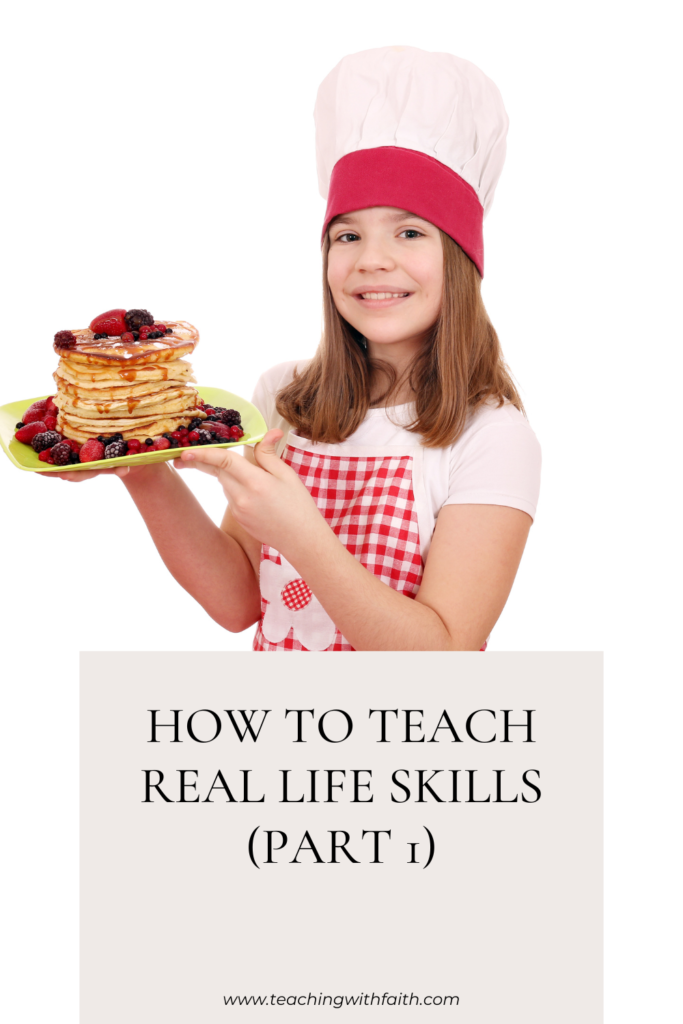
We went to playing with our restaurant dramatic play area. I had C bring me the breakfast menu with the prices and I also showed her how to take my order on the order form. I ordered pancakes, fruit and coffee. She circled the pictures on the order form and then went off to work!
This teaches a ton of social skills: how to wait for a table, practicing manners, how people interact at a restaurant, how to order at a restaurant, etc. This also teaches reading skills because the children will need to match up the words the person orders with the pictures on the order form as well as reading the menu. There are pictures to help prereaders on both the menu and the order form.
It also teaches math skills if you use the menu with prices or write in prices. If you want to use the menus with write in prices, have your child decide how much everything is going to cost before playing. This can also lead into discussions about the value of the dollar (see next section for more extensions). Also using either of these menus can help the child playing the customer to figure out what they can buy for the amount of money they have to spend.
She brought me coffee first and then my fruit and pancakes. After I “ate” them, she cleaned up the table. This teaches the social skills of how to act in a restaurant (again), how to clean up a table (great life skill), communicating with others and listening to others (for example, she had to ask if I was done and wait for an answer), reading nonverbal skills (for example, when I put my fork down shows that I am done eating), etc. She also practiced great motor skills such as picking up and carrying items (fine motor skills) as well as walking around carefully (gross motor skills).
The final step she did was total up my bill. This is a great activity for those children who already know about money or you are introducing addition of money. There are three bills that you can use. The first one has primary lines to write the item and the price. This makes it super easy for a younger child. They can add up the items and tell the customer the amount that is owed.
There is a second bill form that is the same but has no lines to write on. This might be easier for children that have been writing for a bit as they can write as small as they want. There is a third form for more advanced children. This form not only has a space to write the item and the price, but also has a built in set tax ($2) and a place to write in a tip. This is a great way for older children to practice what would really happen at a restaurant. These all can lead to great conversations about addition of money as well as how to pay a bill at a restaurant.
Learning Extensions
I have already listed some extensions above based on the differences in the pages of the pack, but here are some more great ideas to do with your restaurant:
- Setting up a table- add decorations and teach the proper way to set a table
- How to act in a restaurant- the whole experience can be a teaching tool so that your child can go to a real restaurant with no problem!
- Value of the dollar- what can you actually get for the money you have? Give your child a set amount of money and see what they can buy. Let your child have as much money as they want and see the difference.
- Table Manners- use this time to teach your child (and demonstrate) good table manners
- Cooperation- invite other children over so that your child has to share and interact with others while playing
- Sharing- have your children work together (or with other children) in the kitchen to make the food or even taking turns as each part
- Addition- adding up how much the entire bill is going to be
- Division- dividing the bill amongst the different customers (older kids can do this on their own, but also you can teach basic grouping with a younger child too)
- Subtraction- make that change!
- Multiplication-have them multiple the amount of an item that is ordered more than once
- Counting- counting money (even if they don’t know the monetary worth of the bill- if it is $3 have them count out 3 bills no worrying about if they are 1 dollar bills or not)
- Counting- counting the correct number of chairs or place settings needed for the customer
- Counting- counting the correct number of items ordered
- Matching- matching the food to the item ordered or to who ordered it
- Vocabulary- learning and reading the items on the menu
- Writing and Fine Motor Skills- writing the bill or even just circling the item on the order form
- Gross Motor Skills- walking around without failing or knocking something over (we all probably need some practice here)
- And so much more!!!
Grab your own restaurant dramatic play below.